
Does Conservative Art Exist?
Culture Builders vs. Culture Defenders

This post is long and full of images. Your email client may object. Find the original on your Substack app or at http://jdanielsawyer.substack.com
In Jr. High, I discovered “low fantasy.” I was bound to. I’d basically been weaned on The Lord of the Rings (back when you had to actually read it if you wanted something approaching the whole story, as the only filmed versions were the cartoons), the epitome and genre-definer for high fantasy. From the moment I had a library card I was on the hunt for another book that could do that again.
Alas, I did not find it.
Shannara was a pale imitation. Thomas Covenant was too sophisticated to be interesting at the time. DragonLance was confusingly generic. There was no Song of Ice and Fire yet. Wheel of Time was duller than dishwater. For 12-year-old me, there was nothing new to be found in high fantasy, despite the fact that I desperately searched through every bookshelf I ran into.
Nonetheless, one afternoon I found myself sentenced to the hell of a book report, and it couldn’t be of a book I’d read before. I had read every book I owned (those were the days!), and I’d put off deciding on a book until after the library closed. I scraped together all the quarters I could find in the couch cushions and dipped into the mason jar that served as my piggy bank. Once I’d amassed a kingly fortune of $4+tax (which was the standard cover price for a paperback at the time), I swung myself astride my trusty bicycle and pointed my wheels towards the local bookstore a mile distant.
Once there, I made my way back to the fantasy section (the only section I cared about at the time) and started looking for something that grabbed my fancy. I emerged ten minutes later with the first book of a series that looked promising: A Spell for Chameleon, a tale of a young man who is forced to leave his home in the magical land of Xanth for the crime of not developing a magical talent by the time he reaches adulthood.
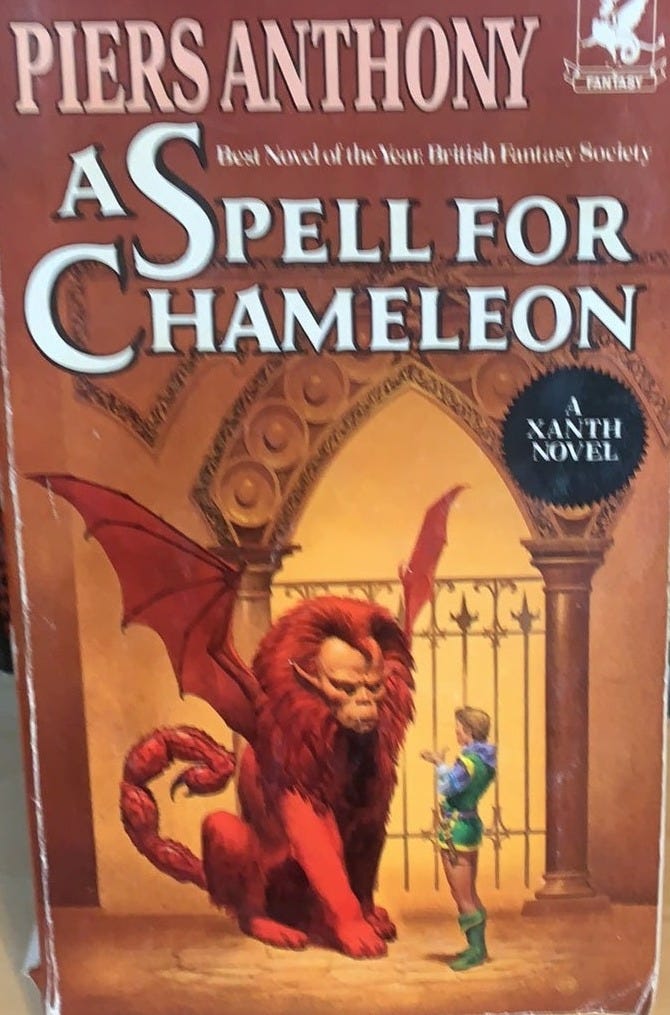
Not a book about grand quests, noble men (or creatures), and the fate of the world in an ambiguously medieval setting—just a simple coming-of-age story about some dude who goes on an adventure.
Low fantasy is about the commoner or common doings: a builder wrestling with a generational curse, a young princess playing with her pet dragon, a thief looting a temple.
I was hooked, and eventually read the first twenty or so in the series before the formula became too narrowly repetitive to hold my interest.
They’re not great literature, but they are fun, playful adventure stories—mind candy, but with a sense of humor that punches a bit above its weight. They’re filled with cheeky sexuality that’s nonetheless mostly-safe-for-kids, and their focus on integrity and honor make them good reading for any Jr. High school kid who isn’t totally unnerved by the cheekiness (I found them just as I was ready for them—I blushed a lot at the innuendos in the privacy of my reading chair). I don’t remember most of the details of some of the stories (as you might expect, some are better than others), but I do remember something I learned from reading that first book in front of others:
Some people do not care about reality. They only care about formality.
The book, you see, has the word “spell” in the title.
A spell is something from witchcraft, which, in the world I grew up in, translates directly to devil worship. A book which is about a spell? That’s not a Disney film where the villain is a witch, that’s a story that’s doing the work of Satan.
And I found out about this the hard way, several times, reading this book that weekend around extended family members who were, to put it gently, “of a conservative bent” compared to Jr. High me (for reference, at the time I was so desperately conservative I read James Dobson books for fun because I was interested in psychology).

The fact that the book had less relationship to the occult than Pringles does to potatoes1 didn’t matter a whit to relatives whose categories held that anything that didn’t fit their personal picture of orthodoxy was, ipso facto, both anti-Christian and satanism.
The formal (i.e. abstract and ideological) was far more important to these people than the real.
I’ve thought about that weekend a lot in the last few years. It first floated back to mind in some 2020 Twitter conversations with New York filmmaker Cody Clarke. Clarke does microbudget filmmaking that ranges (in my estimation) from the bland to the brilliant, and he does it because he’s willing to just take any idea that occurs to him and run with it using available materials. During Covid he made a feature-length iPhone movie called Attack of the Giant Blurry Finger, which somehow successfully blends 1950s schlock microbudget horror with Beauty and the Beast with erotica, winding up with something truly (and bafflingly) sublime. Love or hate his work (and my mileage varies by project), Clarke has the kind of original and audacious creative vision that, in previous eras, would have given him access to the ladders that produced Tarantino, Von Trier, Lucas, dePalma, Coppola, Kubrick, and Chaplin.
It’s floated to mind repeatedly since then, as I encounter people who have—because of their ethnicity, politics, areas of interest, or unwillingness to kiss ass (figuratively or literally)—found themselves locked out of the art business, consigned to doing their own interesting little projects on the margins, occasionally championed on podcasts or in dissident media when they say something politically provocative, but are otherwise ignored. If today’s world were like the world of only two generations ago, these weirdos would have been the analogues of Kurt Cobain (hopefully without the shotgun-centric end), David Mamet, Chuck Palahniuk, Bret Easton Ellis, Robert A. Heinlein, Alan Moore, or J.G. Ballard.
But we don’t live in that kind of world anymore, because today’s world is now populated, almost entirely, by conservatives of the sort I encountered when I read A Spell for Chameleon low these many long years ago.
Idealist, abstract, formalists with a disdain for the real, the visceral, and the beautiful.
These conservatives are everywhere. They run every corporation. They hold almost every major fortune. They dominate both major political parties, and most minor ones.
Our world is in the grip of conservatives.
And, regardless of their political affiliation, conservatives do not make art.
Nor do they sponsor it.
Nor do they value it.
What Conservatism Isn’t
To make any profit out of this rather audacious claim, we must first understand what conservatism is, and how it works. To do so, let’s start with the converse: clearing the mental decks by looking at what conservatism is not.
Brace yourself, because this is a big ask:
Conservatism isn’t political.
I know we’ve all been taught to think about conservatism as a political movement, but that’s just political branding that we’ve allowed to control our thinking (this is a manifestation of formalism).
Coinservatism isn’t “right wing.”
It isn’t even exclusive to the “Con Inc.” ecosystem of podcasts, tweeters, and opinion spouters that style themselves as “pro-family” and “Constitutionalist,” as if their positions add up coherently to either of these things (they don’t—any more than the positions of the “liberals” add up to anything favoring liberty, or any more than the positions of “leftists” add up to advantage for the downtrodden or overthrowing oppressive systems—American politics is a con all the way around. I will not be taking questions on this point at this time).
Despite the workmanlike work of very sharp politically “conservative” thinkers such as Thomas Sowell, political “conservatism” is rarely anything of the sort. You can’t make sense of American politics from the labels or their taxonomy. As the seat of the global empire, all of our political tribes have been the target of subversion, corruption, propagandization, and gamesmanship by foreign interests and by financial and domestic state interests for close to a century—there is no coherence left.
In a coherent political system, those calling themselves conservative would seek to preserve the national character and system against innovation, while those of a more adventurous temperament would seek to stay ahead of changes wrought by industry, geopolitics, and demography so that the nation would retain its character rather than being eroded by the forces of time. Those of a revolutionary bent would be seeking to reboot the entire national consciousness and system using a novel paradigm that did not depend on distant representation and bureaucracy.
Doesn’t sound much like what we’ve got, does it?
So instead, we generally content ourselves that “conservative” means “right wing” while “liberal” means “left wing” (terms which also don’t mean much anymore beyond party loyalty, as anyone who has been an adult for more than twenty years will notice if they lift their nose out of the news cycle).
So if “conservatism” isn’t political, then what is it?
What Conservatism Is
So what is conservatism?
There’s an old political saw that cracks this nut for us quite easily:
“If you’re a conservative at 25 you have no heart. If you’re a liberal at 40 you have no brain.”2
It’s stayed with us, in various forms, since at least the Napoleonic age because it mirrors the development of temperament over the course of the lifespan.
A young man (or woman) who is seeking to find his place in the world is more likely to be willing to bend the world to his will. He has tremendous energy, he knows he is disposable,3 he senses that the whole world is against him, so he’s going to take a hard dogmatic line against those things that stand in his way. If he’s able to find a place in an existing hierarchy, this tremendous energy will express itself as ambition. If he’s not, it may express itself as entrepreneurship, lifestyle experimentalism, crime, terrorism, revolutionary politics, or ideological monomania (meaning: redefining his consciousness in service of an ideology).
This is the way of the liberal mind—an excess of creative energy that must be expressed.
But skip forward twenty years, and you’ll find that most of the time that same man will have a family, or a business, or a career, or property, or some other achievement (or collection of achievements) that have tied him to his life, civilization, hierarchy, and social context. He has something to lose, so his mentality has gradually shifted from creating to conserving. He starts to look with suspicion at political or social movements that promise “change,” because change might jeopardize his life’s work. If he is a particularly selfish person (which is to say, “normal” by today’s standards) he might be attracted to exactly (and only) those kinds which would have prevented his younger self (and will certainly prevent his children) from building the kind of life he now enjoys.
You can see this dynamic clearly in pre-WWII European politics, where conservative” generally amounted to “loyalty to the crown and the nobility” and “liberal” generally amounted to “loyalty to the people and their liberty (however construed).”
Conservatism, in other words, is a form of defensiveness. In the right contexts, it is a kind of wisdom, and a healthy culture (and polity) proceeds from a balance of the creative and the conservative.
Unfortunately, we don’t have that kind of a society.
We in the developed world (not just in America) now live in a gerontocracy, and have done for quite a while. We will continue to do so for the foreseeable future. For longer than I have been alive, our politics have been controlled by a succession of generational cohorts on the backside of middle age (or older) who are all, uniformly, interested in protecting the gains of their youth against the needs of their descendants. As near as I can tell, it started with the establishment of the Global American Empire after World War 2—a national government that’s seeking to conquer the world inherently has a higher risk tolerance and different ethos than a government that is seeking to rule the world. The attitude of a government towards dynamism trickles down to the populace, and the Imperial government has sought always to reduce or eliminate risk and promote stability by any means necessary. The tendency has grown thicker and the system more sclerotic over time.
Don’t kid yourself by thinking that the occasional “young” President in that time (Kennedy, Clinton, Bush, and Obama are the ones that could be so characterized) made any kind of dent in this tendency—all of them took their orders and cues from the highly conservative national security and financial/industrial establishments of their day. This is not a conspiracy theory, this is a statement of bare fact which can be ascertained by looking at the pedigree of Presidential cabinet appointees, and by reading the memoirs of those advisors who have written them.4 Young Presidents are great for political entertainment, but (at least in the Imperial era), their youth provides energy to accelerate the trend-line towards hard-line control-centric conservatism.
Viewed through this lens, even the great “liberalizing” political revolutions of the late 20th century (the welfare state, the Civil Rights movement, Gay Liberation, etc.) are revealed as exercises in reducing liberty and creative energy by extending the smothering reach of the conservative consensus into those areas which were previously culturally energetic (or did you not notice that black music, gay theater, and Jewish comedy have all become dull, ordinary, and entirely consensus-validating since these groups were “included”?).
In a healthy society, the old provide stability while the young provide vitality.
But in a gerontocracy, the old are vampires—they pretend to indulge in the pleasures of youth and avoid growing up (“We’re preventing an entire generation from becoming their parents!” said a popular ad campaign of my youth)5 when, in reality, they are extending their own youth (or a simulacrum thereof) at the expense of their progeny, community, and nation.6
In a gerontocracy, comfort, reassurance, and formalism become the currency of legitimacy.
Art as Propaganda
But I should wrench myself back on track lest I go down that particular rabbit hole and lose sight of the pachyderm on the premises:
One of the hallmarks of a conservative (as defined above) culture is the idea that art is merely entertainment,7 not much different than sports or gambling or picnics with one crucial exception: education. Art is that form of entertainment whose job it is to smuggle messages into the minds of those who are consuming it.
The idea that art be used to deliver messages (especially in the form of moral and social programming) is so banal as to be almost not worth remarking upon. After all, we metabolize the attitudes and ideas in the stories that provide the baseline for our mental mythopoetics, and we do so unconsciously. Tales of knights and cowboys and private detectives (however unhistorical) help give shape to our nascent feelings about social responsibility, justice, leadership, and sacrifice. Tales of wily princesses who outwit old wicked witches and lascivious suitors help give shape to understandings of intersexual competition and intrasexual behavior. These things happen largely below the threshold of conscious awareness because stories are a kind of virtual reality in which we explore parts of the world we are not able to experience directly (whether because we are too young, or to do so would be too dangerous, or whatever).
As we grow, we start to consciously draw on paradigms we were first exposed to in stories to help us deal with new and novel situations, and we sometimes do it as explicitly as the characters in Scream did.8 9
For a long, long time (i.e. thousands of years), professional bluenoses10 have known this, and have attempted to make art into propaganda—embedding “messages” on purpose, attempting to “teach” and “model” proper values and behavior in order to “shape the minds of the young.” This is the model of conservative art. It can bee seen in the work of Thomas Bowdler (who, in the early 19th century, censored Shakespeare to make it “suitable for children” and ignited the craze—still extant—for abridging and tailoring both popular and classic artworks to make them ideologically and/or politically suitable for “modern audiences”).
By controlling the cultural inputs, one might control the person that consumes them—or so the logic goes. Thus, the message of an art is what makes it good or bad, valuable or worthless, important or forgettable.
Not truthfulness.
Not verisimilitude.
Not technical competence.
Not symbolic depth, or resonance, or emotional potency, or beauty, or expertise of execution.
The message.
Art, this view holds, is good for programming people like automatons? If you wish to protect your civilization, social order, morality, and power, you would be wise to pay attention to the propaganda value of art.
What else could art possibly be for?
What is Art For?
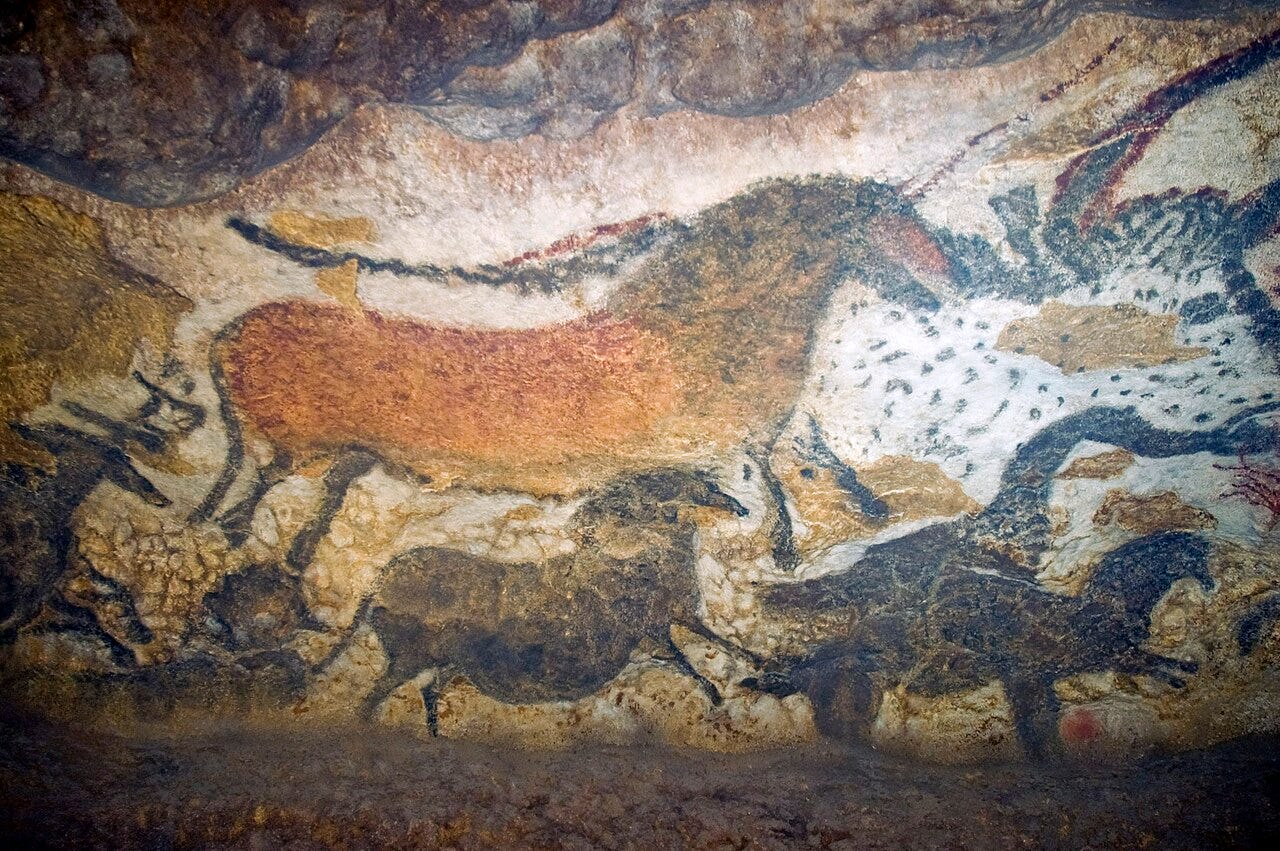
At the time of this writing, that painting is a single pane of a collection of some of the oldest, most beautiful art in Europe. It lives on the walls in Lascaux Cave in France, in a vast collection of Magdalenian paintings dating to around twenty thousand years ago. Long before the first city-states in recorded history, the people who lived in this cave had access to trade networks that stretched from East Asia to the French Coast and down deep into Africa. They recorded their stories—their hunts, their births, their deaths, and some of their religion—in paintings on the walls of these limestone caves.
Humans have since sung songs, written epic poems, told stories of the gods and of distant lands, joked and laughed and danced and held orgies and gotten high and re-enacted great tribal memories around campfires, in amphitheaters, in cathedrals and caves, in cinemas and stadiums. They’ve drawn mouth-sounds on parchment, etched music into vinyl and glass, and carved figures into stone, all in service of collective memory and dreaming.
From before the dawn of what we call “humanity,” art has been the string that the pearls of religion and civilization hang upon. Art commemorates the great deeds of the past, and gives space for our exploration of the spirit/dream world. It unites the people who love it into a fraternity whose bonds are often as strong and lasting as those forged by veterans who fight next to one another on the front-lines of a war.
Do you like Star Trek? So do I. If we were trapped together in an airport lounge (without cell phones or other entertaining distractions) we would talk to pass the time, and discover this bond between us. For an hour or three, we would become fierce adversaries and fast friends based on nothing more than our ability to share our love of that dream-space we’ve both entered into often enough that it has entered into us, and where we’ve both found reflected back to us things about life and self and reality that we hadn’t previously had the words for.
And this would still be true if we were polar opposites politically, religiously, temperamentally, or morally. I could be a Thelemite and you a Catholic. I could be a wokester and you a theonomist. I could be a Republican and you a Democrat. I could be a Black Muslim and you an Orthodox Jew. Even with such gulfs separating us, for those few hours, none of that would matter, because we’d find peace and fellowship in our arguments over the best captain, the best film, whether Q was a good idea, whether Tribbles should represent an existential threat to the Klingon Empire, and whether Deep Space Nine was a critique of Star Trek’s utopianism or a validation of it.
Art knits humanity together, and it does this in spite of whatever messages it comes laden with. The liberal, anti-imperialist, communist-leaning Hollywood New Wave directors of the 1970s (Brian de Palma, George Lucas, Francis Ford Coppola, Martin Scorsese, John Carpenter, etc.) studied the works of Nazi filmmaker Leni Riefenstahl. Tolkien was so steeped in the pagan lore of northern Europe that he created magic systems that would have seemed familiar to a witch or wizard of the 8th century, yet he was himself a devout Catholic. C.S. Lewis drew deeply from the wells of theosophy and dark spiritualism to create his most towering works (Till We Have Faces, The Great Divorce, and The Screwtape Letters), despite he himself being a conventional and earnest low-church Anglican. The bawdy and obscene honkey-tonk rock musicians (like Little Richard) and Jewish folk-rock titans (like Bob Dylan, Neil Diamond, and Paul Simon) drank deeply from the fount of Gospel music.
And, in every case, their works depend upon those influences.
These artists represent well over a hundred years of baseline in Anglo-American art (and German, if you include Riefenstahl, which you should), and they all preached through their art to one extent or another (as did everyone who ever wrote a Star Trek episode). But the art I’ve singled out above usually is not remembered as preachy, because the message in their works were rarely the point of their works—and, even when it was, it’s not the part of their works that mattered in the long run.
So why did their art matter? They sought to express or explore the truth (as they saw it) through the language of their chosen medium so that other people could encounter it through their dream-state. What’s more, they all sacrificed to do it: The hours (or years) of their lives, their fortunes, their sacred honor—reputations took hits, bankruptcies happened, some of them risked their lives because what they attempted to do was dangerous (either practically or politically). Their work was an heroic journey enacted as ritual, and the boon they won was what you wound up listening to on the radio, or reading in a book, or watching on a screen.
Conservatives do not make art like this.
And conservatives often resist enjoying art like this until it has aged enough to grow around it an air of respectability. When the novel becomes the ubiquitous, it’s no longer a danger to be suspected, it’s part of the world that should be protected (simply because it is there).
But even though art makes up the furniture and structure of human civilization, art is not static, staid, or inert. It’s not something that can be defended like property.
Art is alchemy. Literally. It is the transmutation of money, time, creative energy, passion, ambition, and/or experience into something tangible and transferable. When I finish a sculpture or a novel, I have given up a little of my life in exchange for creating something that will last longer than I will live. I have bought a measure of immortality with the sacrifice of my blood (literally, in the case of the sculpture below-right, which cost me a nasty cut on my left hand).


And when that art—good or bad, grand or mean—finds a heart that it touches, the alchemy happens again.
The string of pearls gets a little longer.
Because no artwork exists on its own.
All look back to those things which came before to make sense of the traumas and dramas of the present, and to provide dreams for those in the future who might need them to make sense of the chaos they find in their time.
The Funding Fathers
Since the Gothic era, all great art in the Western world—the sculpture, the architecture, the plays, the literature, the music—has been funded by patrons who sought to gain either status or wealth through their association with the arts.11
This is as true for the great cathedrals of Europe (massive, expensive erections designed to hold the common people in awe and cement their loyalty to Mother Church in a time of fading devotion, rising heresy and schismatic movements, and slowly-emerging materialism) as it is of the great Classical and Baroque music (funded by princes who sought to demonstrate their power and greatness) as it is of the Elizabethan Theater (a nakedly commercial venture) as it is of the great American huckster traditions of the circus, the sideshow, and the traveling tent revival.
Our books? We got those because Johannes Gutenberg needed money to pay off a debt.
The American publishing industry? Created by Benjamin Franklin so he could make a living, extended by pirates and profiteers in the late 19th century, and built, end-to-end on the theft of intellectual property for the sake of making a quick buck (The Lord of the Rings became a best seller in the US was because of a pirated edition).
The film industry was founded to launder mob money into something more respectable (a function it still serves to this day—what, you thought it really took $5-10 million just to shoot a small human drama without visualFX or stunt work?) and expanded into a propaganda arm of the US government.
Broadcast (radio and TV) was licensed and content-controlled by the various governments of the world before it could even get off the ground. Only those people who produced content that appeared to contain the messages that governments and corporate sponsors wanted amplified could get deals.
And yet all that greed, propaganda, theft, chicanery, and control for all those centuries still left us with Shakespeare, Dr. Seuss, Beethoven, Mozart, Kubrick, The Beatles, Metallica, Star Wars, Conan, and The Little Prince. Because the people who wanted control, prestige, and profit were willing to waste a little money, take a little risk, and reap the rewards.
They did this because their position—social, political, and economic—depended upon the goodwill of the people in their community (whom they saw an a regular, day-by-day basis). If you have to get from your house to your friend’s house in a horse-drawn carriage (or a convertible) through streets filled with hoi polloi who despise you, you might wind up suffering injuries due to high-speed lead exposure. If, on the other hand, they like, respect, or idolize you, you’re much less likely to encounter life-threatening traffic jams. And besides, in many instances those peasants who live in the slums are people who you—or your parents—grew up with, and you have a loyalty to them for the help they gave you or your ancestors when times were tough.
But the taint of aristocracy and money laundering—as well as the taint of pornography which comes with it (as pornography is always the primary use of any artistic medium, especially in its early days)—means that, by the 20th century, those of a conservative bent were unwilling to even touch the means of cultural production (except when they could use a censor’s airbrush to do some retouching). The arts were funded—entirely and exclusively—by mafiosos, governments, whores and madams, and the other social undesirables who saw very little percentage in self-righteous priggery.
Those of a conservative bent didn’t go into the arts. They went into banking, administration, government, and other dependable, respectable professions where they could maintain the machinery of civilization and try to control the impulses of the artists and the other anarchists.
Ironically, this meant that they automatically ceded the entire culture to the “left” (i.e. anyone who was not conservative—socialists, vitalists, bellicose American patriots, crazy right-wingers, and religious/ethnic outcasts like Catholics and Jews and Atheists and Occultists and Cowboys and Blacks). They made the art. Respectable conservative Protestants consumed it in secret, and eventually stopped caring so much about respectability (and often became less Protestant or conservative as a result).
But eventually conservatives noticed that they’d lost the culture. Their countermove, when it came, was as laughable as it was predictable. In an era when the avante-garde was producing dazzling surrealist nightmares (like those which came from the European and American underground film scenes in the 30s-70s), conservatives were producing laughable schlock propaganda like the original Reefer Madness, or the stilted A Thief in the Night apocalyptic horror films. Like many in the folk music movement of the same era, they seemed doomed to confuse authenticity with artistic merit, and illiteracy with charm12…which is, really, what you would expect from artwork funded by Evangelical (or similar) bankers.
You can see this kind of cringey “art” in films and books produced by evangelical media to this day—from the Left Behind series to anything featuring a post-Hercules Kevin Sorbo: expensive turds that are so earnest in their messaging that, even though they often have very high production values, they can't help but ignore simple little things like verisimilitude, believable characters, irony, subtlety, or honesty.
If you’re a politically leftishly-oriented person, you’ve had good reason to be smug about your end of the culture for most of the last 200 years: it was always the liberals who made good art, and the only people who weren’t liberal politically who made good art were liberal spiritually—they cared about adventure, and beauty, and the humanities, and it showed through in their work (even if that work was a penny-dreadful serial killer story).
But fate had yet another ironic twist up its sleeve as it wound its poisoned tentacles through the arts scene in the last half century:
The bankers (this includes investment bankers, hedge fund managers, private equity fund owners)—still as conservative as ever—who now own the film studios, the publishing companies, and the streaming platforms (because those were good investments), became political “liberals.” You no longer have to have a cross around your neck or a Republican party membership card to feel horrified at art that shares your point of view. You can now be on the social and political “left” and watch The Colbert Report or a new-ish film from the Disney empire, or read most any YA book or mainstream novel to find “art” that isn’t art, designed to push ideology that is banal, totalizing, and incoherent, that does not even attempt to persuade, and get that same cowering sense of lameness deep in your soul.
The triumph of conservatism over culture is nearly complete. The Church Lady runs every major outlet, left, right, and center.
Even leftism has grown old and conservative. The arts now exist in the cracks between the corporations, in a mishmash stew of ideologies where all the old categories get swapped around and recombined, where even the coordinators of various clubs and interest groups have trouble drawing lines because the artists who are willing to go to the trouble to write books, make movies, make music, act, and dream outside the corporate structure are not usually willing to bend over and conform to a new gatekeeper.
There aren’t a lot of patrons running around these days, because most of the wealth (especially that which needs laundering) is in the hands of legitimate bankers who can’t bear the stench of scandal or controversy. The only interesting new corporate operation in the arts space that I am currently aware of is Ark Press, an old-style publisher which signs science fiction writers of all ideological persuasions as long as they can write well—this despite the fact that it’s financed by Peter Thiel.13
The politically right-leaning have been complaining recently (and loudly) that conservative billionaires and millionaires (some of whom talk a loud game on the importance of culture) won’t open their wallets to finance anyone who doesn’t already work for them, while those who are willing to pretend to be on the political left can still sometimes find patronage. The disparity in arts funding between political tribes is real, but the complaints miss the central, and most important, fact of our age:
Everyone is conservative, and nobody cares about art. Not right, not left, not center. If you’ve got money, it’s (usually) because you were more interested in stock trading than in prestige, risk-taking, or culture, and you probably think “power” is measured by “net worth.”
In a world where the wealthy (and most of the rest of us) never have to come into contact with people they don’t like, one has to ask:
When you don’t need prestige, admiration, or approval to be powerful, why would you ever waste money on funding the arts? Especially when you can buy any art ever made for your own personal enrichment?
Why would someone who lives their life in a spreadsheet ever want to deal with artists—you know, those weirdos who think about gods and monsters and transpersonal values and religion and sex and crime and pain and beauty? All that shit just gets in the way of quarterlies and an orderly life.
Art as Civilization
If you think about language deeply enough, for long enough, something strange will occur to you:
This thing we do with our mouths, these sounds we make? They let us tell other people what we’re thinking. Other animals have to rely on body language and scents to communicate their emotional states—not us. We can control other people’s minds by lying about what we’re thinking, or we can use pretty words to weave a spell that will make them feel what we are feeling (or what we want them to feel). This ability of ours to use words to communicate thought is something one might expect out of a superhero comic, or a science fiction novel. When you and I talk to one another, we are engaging in mind-control and telepathy (albeit, fairly loudly).
With art, we do something even more amazing:
We can make other people see what we see when we close our eyes; hear what we hear when the music and the muse takes us; we can project our dreams into the consciousness of another being. More tender than a whisper, more intimate than sex, when you open one of my books you are caught in my dreams—and when I listen to one of your songs, I feel the rhythms of your body and soul.
When we join together to enjoy art, we make something sacred. The cinemas, be they ever so rare now, are churches. When you dance in a mosh pit you sync your heart-beat to the drums, and your hopping to the thousands of people around you. You make life holy.
Humans didn’t conquer the natural world because we were the smartest—the Neanderthals had us beat on that score. It’s not because we were the strongest—we’re the weakest of the great apes. It’s not because we’re more moral (have you actually seen how we treat each other?). It’s not because we make tools.
It’s because we never lose the ability to play—and when we play together, we don’t just learn from each other and share space, we share dreams. Those dreams allow us to see the world in total perspective, understanding more of it, and willing to explore more of it, than any other creature in the known universe.
It is in these dreams that we find ourselves, and it’s because of them that, when we awake—when we close the book, or end the film, or hum the final chord—we find our world transformed, however slightly, from what it was before.
Not because the world is changed.
But because, in connecting with one another through the dream, we become more than we are alone.
When not haunting your Substack client, I write novels, literary studies, and how-to books. If you’re feeling adventurous click here to find a ridiculous number of fiction and nonfiction podcasts for which I will eventually have to accept responsibility.
If you’re looking for tales to transfix your imagination, you can find my novels, short stories, visions, and dreams (along with some how-to books and literary studies) by clicking here.
This column is a big part of how I make my living—bigger now due to recent exciting events which you can read about here. Because of this, I’m offering a 20% lifetime discount off the annual subscription rate. If you’re finding these articles valuable, I’d be honored to have you join the ranks of my supporters!
Which I can now verify as someone who’s spent the past quarter century studying the history of psychology, religions and magical practices—it comes in handy both for writing and in understanding geopolitics. Learn more here:

There is no definitive provenance on this quote. Versions of it date back hundreds of years, but the sense of it is always the same: young people are radical, old people are conservative.
I explore this issue in considerable depth here:

Ironically, the most agile and innovative administration in that time, stocked with the most maverick young advisory talent, was the Nixon administration (though it pains me to admit it as I am deeply unsympathetic to Nixon’s policy legacy—there is such a thing as bad innovation).
The campaign was for the MTV-adjascent cable channel VH-1.
They don’t just spend their children’s inheritance, they are basically required to do so because the system they are protecting is one that’s based on employment rather than on ownership. But that’s a very long side-quest which I’ll have to get into in a separate article at some point.
In using this term, I am bowing to popular convention. The distinction between high art and popular entertainment is a market segmentation convention. The arts that change the world and become the myths of the future have almost always arisen exclusively from the popular arts rather than the fine arts. I love fine art myself, but that is because it appeals to me on aesthetic grounds in the same way that a good movie, or opera, or photograph, or pulp novel does. Fine art/high art is often held up as being unconcerned with the market, but this isn’t true—it’s just catering to a different market than the popular arts.
As I have just made a point about metanarratives using a metanarrative reference to a work of metafiction, I believe I have earned some kind of literary theory oroborous medallion. An orin, perhaps?
In case you haven’t seen Scream, here’s a representative scene that depicts this story-based reasoning:
For those f you unfamiliar with this term, it refers to people of a persistently priggish and busybody-ish disposition. Think of the conservative mentality as I have described it, then project it onto the Karen archetype, and you get an idea.
This also was the norm in the ancient world, but receipts are harder to find for any given work.
Apologies to Tom Lehrer
Unfortunately, they only buy all-rights, so that’s a nope from me.
@tedgioia frequently posts about how the major media companies are spending all their money to buy back catalogs instead of funding new music. That observation fits beautifully into the thesis of your essay.
I have often noticed people (including me) who are adamantly politically opposed to each other, getting along just fine, as long as they don't discuss politics.
The pragmatist in me concludes that politics is not the solution, it is the problem.